NABL Accreditation Checklist
Is your laboratory truly prepared for NABL accreditation, or are there hidden compliance gaps that could delay the assessment? Many laboratories believe they are ready until the official evaluation reveals missing documentation, incomplete quality records, inadequate staff competency records, or inconsistent implementation of standard procedures.
Achieving NABL Laboratory Accreditation is not simply about submitting an application; it requires building a systematic quality management framework that supports reliable testing, accurate reporting, and continuous improvement.
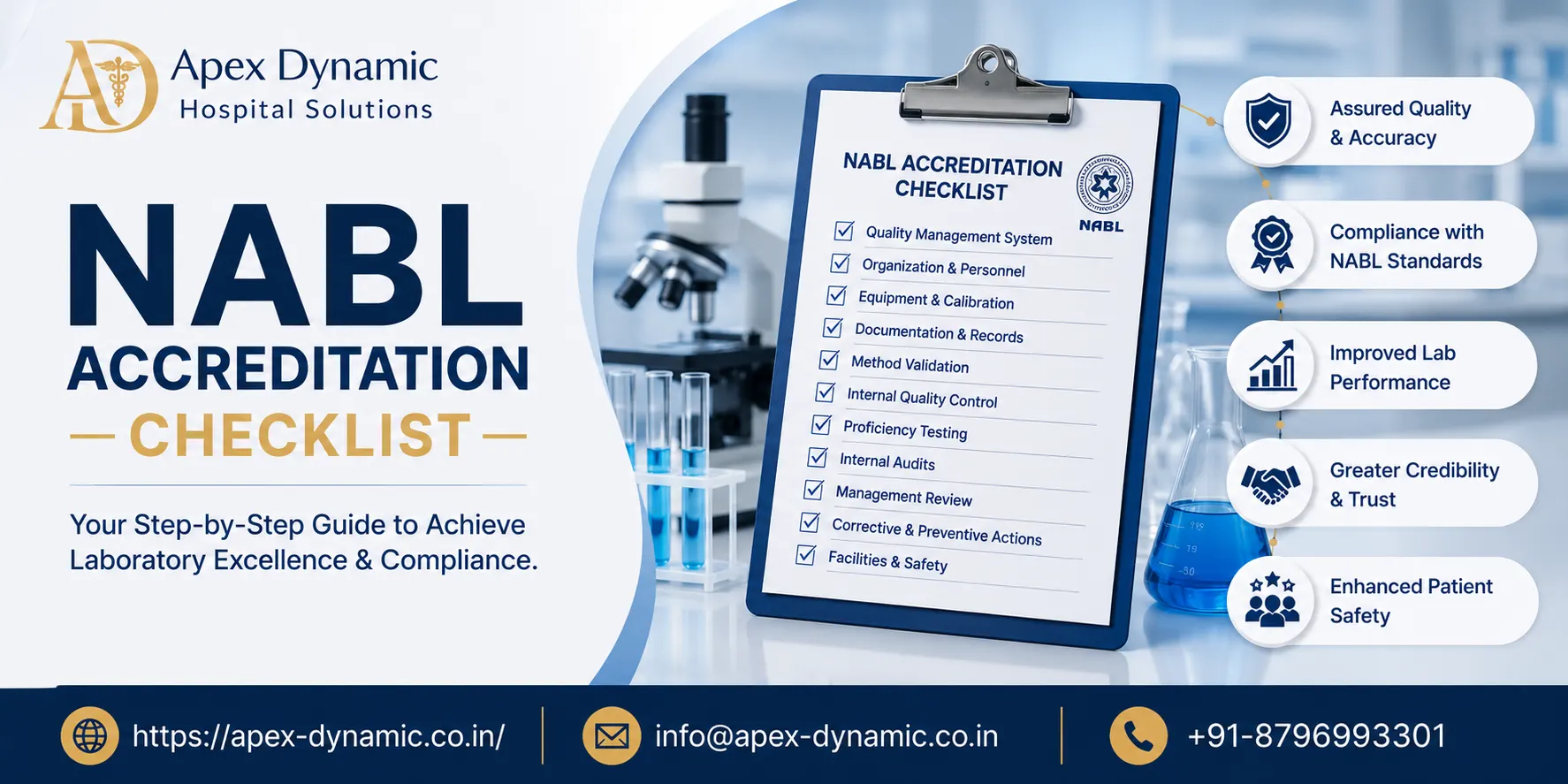
A well-prepared checklist helps laboratories organize every aspect of compliance before the assessment begins. Whether it is a standalone diagnostic laboratory, a hospital laboratory, or a specialized testing facility, following a structured NABL accreditation checklist reduces unnecessary delays and improves readiness for assessment while strengthening laboratory quality for the long term.
Why is a NABL Accreditation Checklist important before applying?
Preparing for accreditation without a structured checklist often results in missed requirements, repeated documentation work, and unnecessary corrective actions. A checklist acts as a roadmap that allows laboratories to evaluate every area of operation before the official assessment.
Instead of focusing only on technical testing, laboratories review documentation, quality management practices, equipment maintenance, staff competency, environmental conditions, sample handling procedures, internal audits, corrective actions, and record management. This organized approach makes implementation more systematic and easier to monitor.
Many organizations begin by consulting a NABL Accreditation Consultant, NABL Consultant India, or Healthcare Quality Management Consultant to understand the scope of accreditation and prepare a realistic implementation plan.
What documents should be included in the NABL accreditation checklist?
Documentation is one of the most important components of laboratory accreditation. Every quality process followed inside the laboratory should be supported with proper records and written procedures.
Laboratories generally prepare a quality manual, organizational structure, Standard Operating Procedures, work instructions, quality policies, document control procedures, record retention policies, risk management procedures, sample handling protocols, complaint management procedures, internal audit procedures, corrective and preventive action formats, equipment maintenance records, calibration records, training records, quality control data, and management review reports.
Many laboratories seek support through NABL Documentation Services, NABL Compliance Consultant, or NABL Quality System Implementation guidance to ensure documentation remains practical and aligned with accreditation requirements.
Well-structured documentation not only supports compliance but also improves consistency throughout laboratory operations.
Why is a Quality Management System essential for NABL accreditation?
A laboratory cannot achieve long-term quality by relying only on technical expertise. It also requires a structured management system that ensures consistency across every activity.
A strong Quality Management System for Hospitals and diagnostic laboratories establishes standardized procedures for documentation, quality monitoring, corrective actions, staff competency, equipment maintenance, internal audits, and continuous improvement.
Rather than responding to problems after they occur, laboratories develop preventive systems that minimize errors and improve reliability.
Organizations implementing Diagnostic Lab Accreditation often strengthen both management systems and technical procedures simultaneously to build sustainable quality practices.
How should equipment management be included in the checklist?
Laboratory equipment directly affects testing accuracy and reliability.
Every instrument should have documented installation records, maintenance schedules, preventive maintenance logs, calibration certificates, equipment qualification reports, operating procedures, repair history, and performance verification records.
Equipment should also be properly identified, monitored, and maintained according to established schedules. Staff responsible for operating laboratory equipment should receive adequate training and demonstrate competency before performing testing independently.
Proper equipment management contributes significantly to successful NABL Laboratory Accreditation because it ensures test results remain accurate and reproducible.
Why are staff competency and training important during accreditation?
Laboratory quality depends on both equipment and people.
Every employee should clearly understand laboratory procedures, quality policies, documentation practices, sample handling methods, safety protocols, equipment operation, quality control procedures, and reporting requirements.
Competency assessments help laboratories verify that personnel possess the required knowledge and practical skills for assigned responsibilities.
Organizations often conduct structured training sessions before accreditation to strengthen implementation. Similar quality-focused learning approaches are also common in NABH Training for Hospitals and NABH Training Services, where continuous staff education supports long-term compliance.
Maintaining updated training records forms an essential part of the accreditation checklist.
How should sample management be addressed in the checklist?
Sample handling influences the reliability of every laboratory report.
The checklist should verify that procedures exist for sample collection, identification, transportation, storage, acceptance, rejection, processing, testing, reporting, and disposal.
Each sample should remain traceable throughout the testing process. Proper labeling, documentation, storage conditions, and handling procedures reduce the possibility of identification errors or sample deterioration.
Standardized sample management improves laboratory efficiency while strengthening confidence in reported results.
Why is internal quality control necessary before assessment?
Internal quality control demonstrates that laboratory processes consistently produce reliable results.
Laboratories monitor quality control samples, analyze trends, investigate deviations, document corrective actions, and review testing performance regularly.
Participation in proficiency testing programs and inter-laboratory comparisons further supports confidence in laboratory performance.
These activities help identify potential issues before they affect patient reports or assessment outcomes.
Many laboratories working with a NABL Audit Consultant use internal quality reviews as preparation for external accreditation assessments.
How do internal audits strengthen accreditation readiness?
Internal audits provide an opportunity to evaluate compliance before official assessors visit the laboratory.
Audit teams review documentation, observe laboratory activities, verify equipment records, examine sample management practices, evaluate quality indicators, review corrective actions, and interview laboratory personnel.
Instead of treating audits as inspections, successful laboratories use them to improve systems continuously.
Organizations working with a NABL Accreditation Consultant frequently conduct multiple internal audits during implementation to ensure every department remains assessment-ready.
Why is risk management included in the NABL checklist?
Modern laboratory quality systems focus not only on correcting problems but also on preventing them.
Risk assessment identifies potential failures related to equipment, sample handling, reporting, environmental conditions, staffing, documentation, information management, and testing procedures.
After identifying risks, laboratories implement preventive measures, monitor effectiveness, and periodically review improvement opportunities.
A proactive risk management approach strengthens operational reliability while supporting continuous quality improvement.
How should laboratory safety be evaluated before accreditation?
Laboratory safety is an essential part of quality management.
The checklist should include biosafety procedures, chemical handling protocols, waste management systems, emergency preparedness, personal protective equipment availability, fire safety arrangements, spill management procedures, electrical safety measures, and environmental monitoring.
Safe laboratories protect employees, patients, visitors, and test integrity simultaneously.
Proper safety implementation also supports compliance with broader healthcare quality systems.
Can hospital laboratories integrate NABL and NABH quality systems?
Yes. Many hospitals operate both patient care services and diagnostic laboratories under the same organization.
While NABH Hospital Accreditation focuses on overall hospital quality, NABL Accreditation for Diagnostic Labs concentrates specifically on laboratory competence and testing quality.
Hospitals often integrate documentation practices, quality monitoring, training programs, internal audits, equipment maintenance, and management reviews to improve efficiency across both accreditation systems.
Organizations working with Hospital Accreditation Services, Healthcare Consultancy Services, Hospital Compliance Consultant, or Healthcare Quality Consultant frequently coordinate NABH and NABL implementation simultaneously.
How does accreditation support future healthcare compliance initiatives?
Healthcare organizations that establish strong documentation and quality systems often find it easier to pursue additional compliance programs in the future.
Requirements related to CGHS Empanelment Consultant, CGHS Empanelment Services, CGHS Hospital Empanelment, CGHS Approval Process, ECHS Empanelment Consultant, ECHS Hospital Registration, Healthcare Empanelment Services, Government Hospital Empanelment, CGHS Empanelment Consultancy Services, and ECHS Empanelment Consultant frequently benefit from organized documentation, quality monitoring, and structured compliance systems already developed during accreditation.
Why do many laboratories seek implementation guidance?
Preparing for accreditation involves documentation, quality planning, staff training, equipment management, audits, corrective actions, and continuous monitoring.
Laboratories located in NABL Consultant Delhi NCR, or hospitals working with a NABH Consultant Delhi, NABH Consultant Delhi NCR, NABH Consultant Gurgaon, NABH Consultant Noida, NABH Consultant Ghaziabad, NABH Accreditation Delhi NCR, Healthcare Consultant Delhi NCR, Hospital Accreditation Consultant Near Me, NABH Accreditation Consultant Delhi NCR, or a Best NABH Consultant in India often use structured implementation plans to improve readiness while maintaining consistent quality across departments.
The ultimate objective remains the same—building reliable healthcare systems that consistently deliver accurate laboratory services and safe patient care.
Frequently Asked Questions
Need Professional Guidance for NABL Accreditation?
Whether your laboratory is planning for NABL Laboratory Accreditation, Quality Management System Implementation, Documentation Development, Internal Audits, Staff Training, Equipment Management, Mock Assessments, or integrated NABH and NABL compliance, Apex Dynamic Hospital Solutions provides complete consultancy, documentation, implementation, training, and quality management support for laboratories and healthcare organizations across India.